Common Mistakes Beginner Foragers Make in the UK (and How to Avoid Them)
Foraging looks straightforward from the outside: walk out, pick something, take it home, eat it. In practice there is a little more to it than that. The mistakes beginners make are rarely dramatic. They are small assumptions about what is allowed, what is safe and how much a patch can give before it starts to suffer. The good news is that every one of them is easy to fix once you know it exists.
Picking First and Asking Permission Later
The most common beginner error is not a plant or a fungus. It is an assumption — that anything growing wild is free to take. The rules depend on where you are, what you are picking and what you intend to do with it.
Broadly speaking, in England, Wales and Northern Ireland, picking wild mushrooms, fruit, flowers and foliage for your own use is generally not treated as theft, provided you are not selling it. Uprooting a plant without the landowner's permission is a different matter, and some species are protected by law. In Scotland, access rights allow you to gather wild mushrooms, berries, flowers and foliage for personal consumption, but not for commercial use. On top of that, nature reserves, forestry land, country estates and many councils have their own byelaws, and picking may be restricted or banned entirely.
Before you fill a bag, run through a few questions:
- Do I know who owns or manages this land?
- Are there signs, byelaws or a website setting out what is allowed?
- Am I on a Site of Special Scientific Interest, a reserve or another protected area?
- Am I hoping to sell or use this commercially? If so, permission comes first, not afterwards.
If any answer leaves you unsure, ask the landowner or the relevant authority. Access rules and protections do change, so for anything that matters, take proper advice rather than trusting a forum post.
Identifying on Hope Rather Than Evidence
This is where foraging turns genuinely dangerous. Something that looks like the plant or fungus in your book may not be that species at all. The death cap and the destroying angel are among the most poisonous fungi in the UK, and young specimens can be confused with edible species by anyone working from a picture alone. Wild garlic leaves have lookalikes that are not edible; the giveaway is the smell of garlic when you crush a leaf.
The workable standard is simple: only eat something you can identify with complete confidence, and only after checking more than one source. An app, a single photograph or a friend's say-so is not enough for a species you have never prepared before.
Habits that make identification safer
- Cross-check two field guides, comparing features rather than just matching pictures.
- Note habitat, nearby trees, soil, smell and time of year. These details narrow things down quickly.
- With fungi, take a spore print and examine the base of the stem. Many species cannot be identified without the whole specimen intact.
- Cut rather than pull when you are gathering for the kitchen, but for a difficult identification, take a complete specimen if the site rules allow it.
- Keep one uncooked piece of anything new in the fridge, wrapped and labelled, so that a specimen is available if someone becomes unwell. If anyone does feel ill after eating wild food, seek medical help promptly.
If in doubt, leave it out. No mushroom is worth a night in hospital.
Taking More Than the Patch Can Give
The beginner's instinct is to take everything in sight, especially when a patch is generous. That is hard on the species and hard on the next person along. A plant stripped of its leaves has less energy for the season ahead; a wood cleared of every edible mushroom produces fewer spores, and there is less for the wildlife that depends on them.
Take a small share instead. Spread your picking across several plants or several parts of a wood, and leave the healthiest specimens to reproduce. With leaves, take a few from each plant rather than all of them. With flowers, elderflower heads included, leave plenty to set fruit. With roots, bulbs and whole plants, ask whether you need them at all, because that is where the damage is hardest to undo. Rare or slow-growing species are best left alone entirely, however tempting they look.
Leaving the Habitat Worse Than You Found It
Damage is not always about what you take. Kneeling in the same spot repeatedly, trampling young growth, pushing through undergrowth during nesting season or compacting soil beside a favourite tree all leave a mark. Fungi are the fruiting bodies of a much larger organism living in soil or wood, and the part you cannot see is the part that keeps the whole thing going.
Stay on paths where you can, watch where you put your feet, and leave gates as you find them. Do not peel bark, snap branches or pull up moss for the sake of a better view of something. Take litter home, never leave plastic bags hanging in a hedgerow on the assumption you will collect them later, and keep dogs out of sensitive ground.
Forgetting the Journey Between the Hedge and the Plate
What you pick is not automatically clean. Roadside verges carry exhaust and tyre dust, field edges may have been sprayed, and verges popular with dog walkers are exactly what you would expect. Wash everything thoroughly, cook what needs cooking, and avoid anything growing close to a busy road or directly on a well-used footpath.
Introduce new wild foods one at a time and in small amounts rather than building a whole meal from unfamiliar ingredients. Allergies and sensitivities are personal, and no field guide can predict them. Check yourself for ticks after a day in long grass, and speak to a pharmacist or doctor if something does not feel right.
Simple Habits That Make Foraging Better
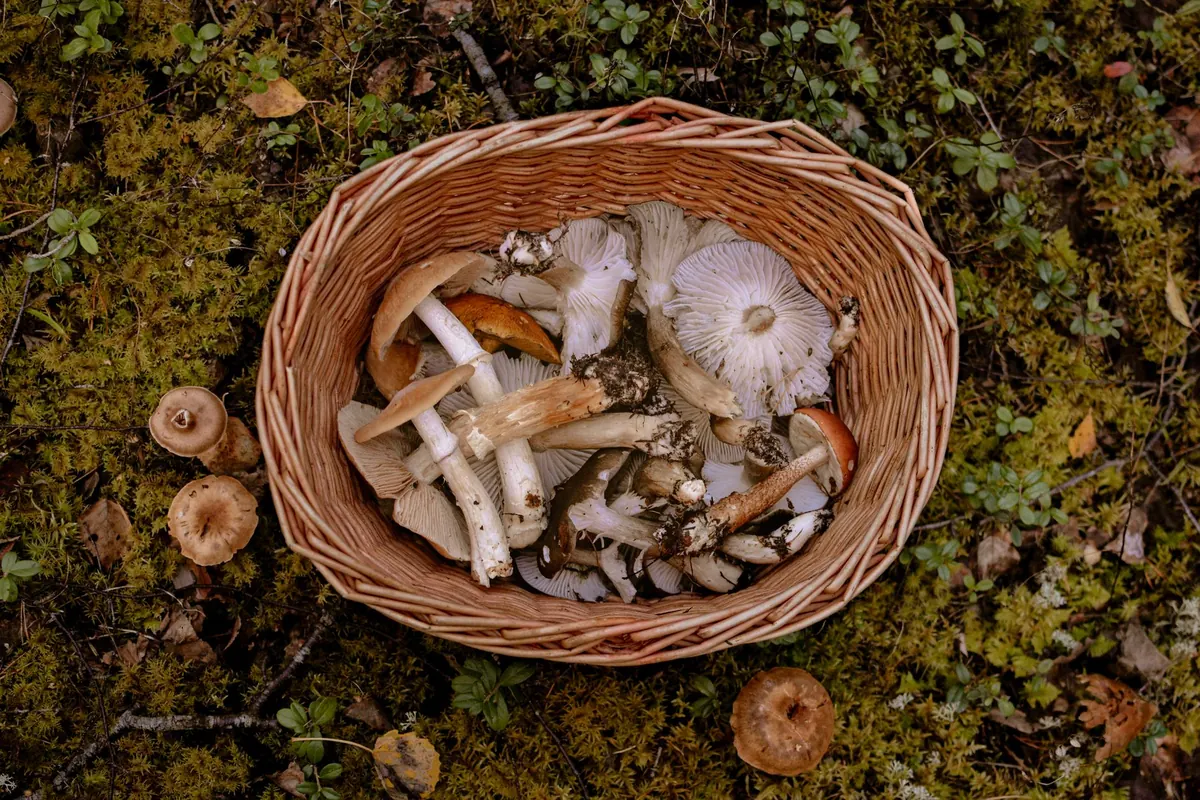
- Carry a basket or a breathable cotton bag rather than a sealed plastic one, so fungi and leaves do not sweat and spoil.
- Take a small knife, a soft brush and a notebook.
- Learn three or four species properly in your first year instead of dabbling in twenty.
- Pick with clean hands and keep your harvest away from soil and damaged plant material.
- Write down where and when you found things. The same patch will differ next month and next year.
- Leave no trace: no litter, no broken branches, no uprooted bulbs.
- Pass on what you know, and point other beginners towards reliable sources.
Start Small and Stay Curious
Foraging rewards patience far more than enthusiasm. Choose one species you can identify reliably — nettles, sorrel, blackberries, or wild garlic where the smell is unmistakable — and follow it through a full season. Learn the land you are on, ask permission where it is needed, and take less than you think you should. Do that, and you will come home with less in your basket but a good deal more in your head, and the places you love will still be worth returning to next year.
Photo: carboxaldehyde / Pexels
Coppicing Explained: Why Traditional Woodland Management Helps British Wildlife
Coppicing — cutting trees near the ground so they regrow — keeps British woods light, open and rich in...
Hedgehog or Badger? How to Identify Night-Time Garden Visitors in the UK
Learn to tell hedgehogs, badgers and other night-time garden visitors apart by their tracks, droppings,...
About Us