British Woodland Flowers Month by Month: A Seasonal Spotting Guide
A British wood in February and the same wood in July feel like two different places. The trick is knowing what to look for, and roughly when. Woodland flowers keep a schedule set by light: most of them bloom before the canopy closes overhead, which is why spring takes the lion's share of the colour. Here is a year-round guide to the blooms — and fungi — worth planning a walk around, along with the timing quirks that catch people out.
Late Winter: Snowdrops, Aconites and First Stirrings
Snowdrops are the first proper event of the woodland year. In sheltered, south-facing spots in the south-west you might catch them in December, but most of the country sees them from early January, with the main flush running through February. They are long naturalised rather than truly native, and the biggest colonies tend to sit near old houses, churchyards, boundary banks and former gardens — a drift of snowdrops is often a map of a forgotten garden.
Winter aconite follows a week or two behind: a low, glossy, buttercup-yellow flower with a green ruff, fond of the same ground. Hazel catkins hang through January and February, and by the end of the month lesser celandine opens its first glossy yellow stars on damp banks. Look closely at the leaf litter and you will see the spears of bluebell and wild garlic shoots already pushing through.
March: Wood Anemones, Primroses and Dog's Mercury
March belongs to the wood anemone. The flowers open white, often with a pink wash underneath, and they close at dusk and again before rain — a starry carpet at ten in the morning can look almost bare by four. The plant spreads by creeping rhizome rather than seed, so dense drifts are a decent sign of old, undisturbed woodland.
Primroses prefer the edges, where the light is stronger: sunny banks, verges and ride sides. Dog violet appears in the same places, and if you find sweet violet, its scent is worth crouching for. Dog's mercury carpets the floor with small green flowers that are easy to walk past. On chalk and limestone, early purple orchid can be in flower by mid-April — spotted leaves first, then the purple spire.
Late April and May: Bluebells and Wild Garlic
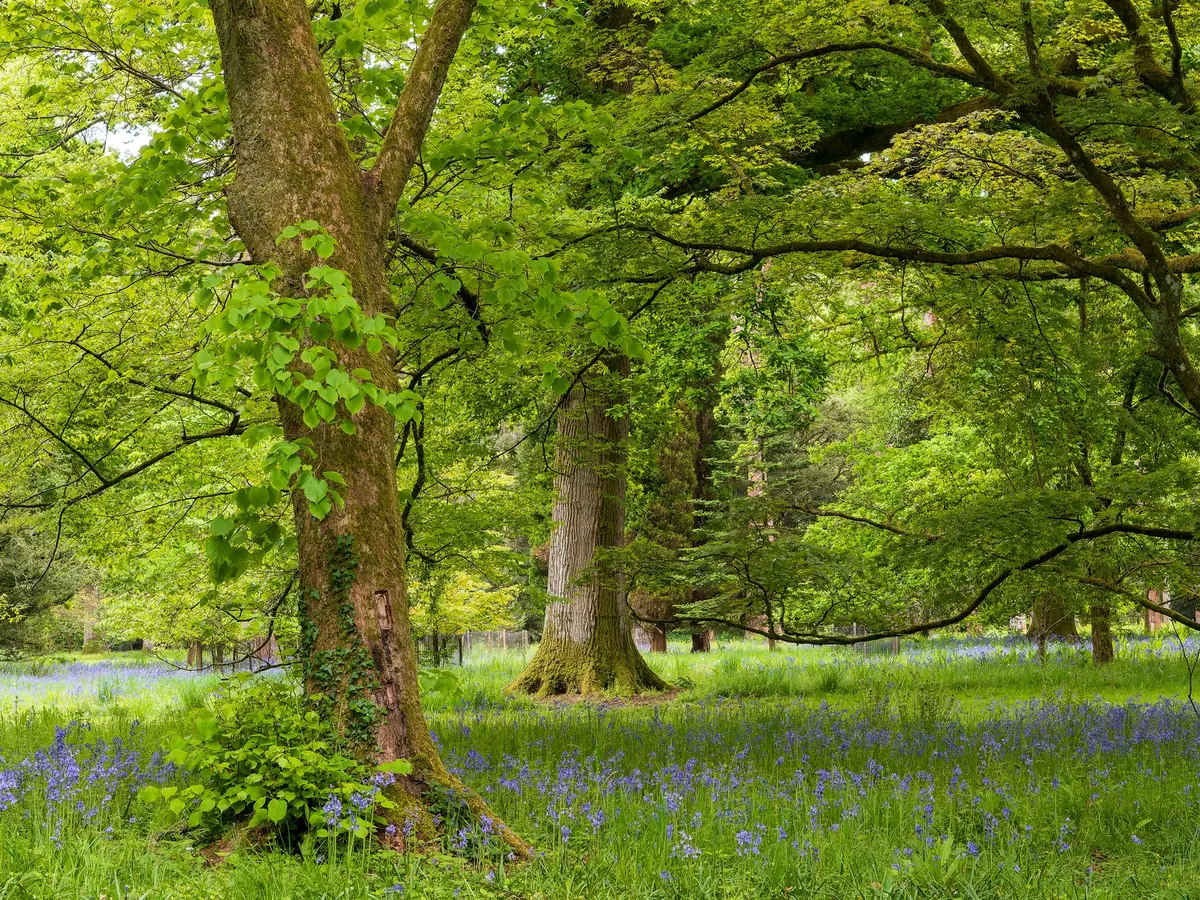
Bluebell timing is what people ask about most. Start looking in the last week of April across southern England, the Midlands and Wales, with the peak usually falling in the first fortnight of May. Northern England and Scotland run one to three weeks later, and every hundred metres of altitude can add a few more days. A cold, wet spring delays the flush; a warm April pulls it forward. As a rough rule, if the beech is coming into leaf, the bluebells are close to their best.
Native bluebells are worth telling apart from the garden hybrids that have escaped around towns and villages:
- Flowers hang from one side of the stem, forming a nodding, one-sided spike
- Deep violet-blue bells with cream-white pollen inside
- A sweet, faintly honeyed scent
- Narrow leaves, with the plant usually well under 40cm tall
Hybrids are stouter, with flowers around every side of the stem, blue pollen, paler colour, wider leaves and almost no scent. Wild garlic, or ramsons, flowers at the same time, and you will often smell it before you see it: white star clusters above broad soft leaves, carpeting damp, slightly acid ground. Scratch a leaf gently and the garlic smell is unmistakable. Sweet woodruff, yellow archangel and bugle fill in the gaps on heavier soils.
June and July: Foxgloves, Orchids and the Shifting Light
By June the canopy has closed and the woodland floor sits in deep shade. The flowers move outwards, to rides, clearings, edges and recently felled patches. Foxgloves are the headline act — tall spires of pink-purple, occasionally white, opening from the bottom upwards while bees work them in sequence. They are biennials, flowering in their second year and then dying, which is why they appear in waves and vanish again for a season or two.
Damp, open woodland holds common spotted orchid, sometimes in real numbers where grazing or cutting keeps the grass down. Look also for herb Robert with its small pink flowers and reddening stems, wood avens with its yellow petals and burr-like seed heads, and yellow pimpernel trailing through the shade. In the wettest corners, meadowsweet brings its froth of cream and its heavy, sweet smell. Enchanter's nightshade opens tiny white flowers later in the summer, on stems that seem to lean away from the light.
August to October: Fungi, Berries and the Second Act
Late summer is the quiet stretch for woodland flowers. Then the fungi arrive and the whole character of a walk changes. Strictly they are not plants at all, but a British woodland calendar without them would miss the best part of autumn.
Fly agaric beneath birch and pine is the one everybody recognises. Amethyst deceiver hides in beech leaf litter, penny bun favours woodland edges, and sulphur tuft erupts in dense yellow clumps on dead stumps. Fruiting depends on warmth and moisture together: a wet spell after a warm September usually produces the best displays, and a dry autumn can shut the whole thing down. Berries and seeds take over above: red rowan, holly, guelder rose, and spindle with its extraordinary pink and orange capsules splitting to reveal orange seeds.
If you want to eat wild fungi, learn from an experienced forager and never cook anything you cannot identify with total certainty. Mistakes can be serious, and no guide on a screen replaces time in the field with someone who knows the species.
November and December: Mosses, Ferns and Next Year's Promise
Once the leaves are down, the woodland floor becomes a different world. Mosses, lichens and ferns take the light — hard fern, polypody, male fern, and glossy hart's tongue on lime-rich banks. Ivy flowers late and is a genuine lifeline for insects on mild days, and holly berries brighten the hedges. Then, on a mild December walk, look for the first pointed snowdrop tips pushing through the leaf litter. The calendar has come full circle.
Practical Tips for a Year of Woodland Spotting
- Allow for latitude, altitude and weather. The same species can flower three weeks apart between Cornwall and the Highlands.
- Go early. Light is better, flowers are open, and you will have the wood to yourself.
- Stay on the paths through flower drifts. Bluebell and anemone leaves photosynthesise for only a short window, and trampled plants take years to recover.
- Leave the plants where they are. Uprooting wild plants without the landowner's permission is against the law, and picking flowers deprives the wood and everyone who walks it after you.
- Carry a hand lens and a
Photo: Bob Jenkin / Pexels
Coppicing Explained: Why Traditional Woodland Management Helps British Wildlife
Coppicing — cutting trees near the ground so they regrow — keeps British woods light, open and rich in...
Hedgehog or Badger? How to Identify Night-Time Garden Visitors in the UK
Learn to tell hedgehogs, badgers and other night-time garden visitors apart by their tracks, droppings,...
About Us